
|
|
 | |

Showing posts with label design. Show all posts
Showing posts with label design. Show all posts
Wednesday, February 26, 2014
The Art of Product Design


Design
| The Art of Product Design by Hardi Meybaum explains the rise of Open Engineering, a way of breaking down barriers and taking advantage of web-based communities, knowledge, and tools to accelerate the design and manufacturing processes. |
explains the rise of "Open Engineering," a way of breaking down barriers and taking advantage of web-based communities, knowledge, and tools to accelerate the design and manufacturing processes.The book helps explain how to establish open flows of information inside and outside an organization, increasing the quality and frequency of input from different groups and stakeholders.

Wednesday, September 25, 2013
Box Integrates Graphics, Acting and Robotics In Brilliant Piece
Film
| What do you get when you combine robotics, projection-mapped 3D computer graphics, and an actor all working together in perfect synchronization. It's a five-minute short film called "The Box" — and it is amazing. |
The short film was produced by San Francisco-based design and engineering firm Bot & Dolly.
The creators describe the film as being both an “artistic statement and technical demonstration”, one that explores “the synthesis of real and digital space through projection mapping on moving surfaces”.
The creative director for Box is Tarik Abdel-Gawad, who also worked on the upcoming film, Gravity, controlling robotics for the complicated special effects sequences of the film.


“Box” explores the synthesis of real and digital space through projection-mapping on moving surfaces. The short film documents a live performance, captured entirely in camera. Bot & Dolly produced this work to serve as both an artistic statement and technical demonstration. It is the culmination of multiple technologies, including large scale robotics, projection mapping, and software engineering. We believe this methodology has tremendous potential to radically transform theatrical presentations, and define new genres of expression.
To create this stunning effect, Bot & Dolly used an actor, two high-resolution projectors, two 2D monitors, and three industrial robots (one for the camera) that were synchronized and controlled by integrating their own software with Autodesk Maya.

What is more amazing is that this is a live performance captured in-camera.
SOURCE Colossal
| By kree8tiv | Subscribe to kree8tiv |
Monday, June 10, 2013
Remembering Niels Diffrient

Design
| The iconic American industrial designer, Niels Diffrient has passed away at the age of 84. Diffrient will be remembered for his bringing ergonomics to the fore in design and for his famous Freedom Chair. |
The iconic American designer has passed away at the age of 84.
Diffrient's three-volume reference work, Humanscale, explores the relationship of spine to chair and other "human engineering" data necessary for highly specialized workplaces such as a cockpit or a truck cab, as well as aiding in the search for the perfectly comfortable place to sit down.
In the field of furniture design, most notably ergonomic seating, Niels won a total of 24 awards, including two Best of Show and 10 Gold and Top awards. Diffrient holds more than 46 design and utility patents on furniture designs in America and abroad, and his many honors include the I.D. (magazine) Top 40 Design Innovators of 1996, the 1996 Chrysler Award for Innovation, the Smithsonian’s 2002 Cooper-Hewitt National Design Award for Product Design, and the 2005 Legend Award from Contract magazine.
In the field of furniture design, most notably ergonomic seating, Niels won a total of 24 awards, including two Best of Show and 10 Gold and Top awards. Diffrient holds more than 46 design and utility patents on furniture designs in America and abroad, and his many honors include the I.D. (magazine) Top 40 Design Innovators of 1996, the 1996 Chrysler Award for Innovation, the Smithsonian’s 2002 Cooper-Hewitt National Design Award for Product Design, and the 2005 Legend Award from Contract magazine.

Friday, April 26, 2013
Self-Assembling Furniture

Design
| Carl de Smet has developed a concept for self-assembling furniture that’s just as cool to watch. Once removed from the box, his block of smart foam quickly unfolds and stretches into a perfectly useable chair. |
The technology arrives at a dynamic moment in materials design. With 3D printing becoming affordable enough to use for more than just prototypes, other designers, entrepreneurs, and researchers are either reviving older techniques that the 3D printing craze has overshadowed or introducing even newer concepts, like 4D Printing another smart materials concept rolled out at TED last month.

SOURCE Fast Company Co.Exist
| By kree8tiv | Subscribe to kree8tiv |
Tuesday, April 16, 2013
Fonts & Colors That Drive the World’s Top Brands

Graphic Design
| Tasty Placement's infographic provides some good food for thought if you’ve hit a roadblock on your latest logo design. |
Their infographic provides some good food for thought if you’ve hit a roadblock on your latest logo design.

The team found that most brands opt for a blue logo featuring the world’s most popular sans-serif font, Helvetica. Serif fonts ended up being the least used typeface, although it hasn’t stopped Google from being listed as the #5 top brand in the world.

SOURCE Tasty Placement
| By kree8tiv | Subscribe to kree8tiv |
Thursday, April 11, 2013
Timothy Samara's Design Elements Is Accessible and Informative

Books
| Timothy Samara's book, Design Elements: A Graphic Style Manual, available in print and on Kindle is simply the most compact and lucid handbook available outlining the basic design principles of layout, typography, color usage, and space. |
imothy Samara's book, Design Elements: A Graphic Style Manual , available in print and on Kindle is simply the most compact and lucid handbook available outlining the basic design principles of layout, typography, color usage, and space.
Being a creative designer is often about coming up with unique design solutions. Unfortunately, when the basic rules of design are ignored in an effort to be distinctive, design becomes useless. In language, a departure from the rules is only appreciated as great literature if recognition of the rules underlies the text.
Graphic design is a “visual language,” and brilliance is recognized in designers whose work seems to break all the rules, yet communicates its messages clearly.
, available in print and on Kindle is simply the most compact and lucid handbook available outlining the basic design principles of layout, typography, color usage, and space.Being a creative designer is often about coming up with unique design solutions. Unfortunately, when the basic rules of design are ignored in an effort to be distinctive, design becomes useless. In language, a departure from the rules is only appreciated as great literature if recognition of the rules underlies the text.
Graphic design is a “visual language,” and brilliance is recognized in designers whose work seems to break all the rules, yet communicates its messages clearly.
Thursday, April 4, 2013
The Role Of Designers In Creating A Better World
Design
| Design visionaries Peter Diamandis, Cameron Sinclair, Eve Blossom, Christine Furstoss, Brian David Johnson, and Mickey McManus give their thoughts on the role of designers in creating a better world. |
SOURCE Autodesk
| By kree8tiv | Subscribe to kree8tiv |

Tuesday, March 19, 2013
Casey Reas - How To Draw With Code
| Artist Casey Reas uses software code to express his thoughts—starting with a sketch, composing it in code, and witnessing the imagery that it ultimately creates. Using the software he helped to create, Reas uses color to convey emotion and movement. |
In the video above, Reas is at work his studio where he uses color to convey emotion with his programming language Processing. —
Together with Ben Fry, he created the software while at MIT, and it is now used by thousands of artists and designers worldwide.
A former student of John Maeda, Reas is an artist whose conceptual and minimal works explore ideas through the contemporary lens of software. Reas’s software and images derive from short text instructions explaining processes that define networks.
Reas attributes his involvement in the creation of the programming language Processing to Maeda’s book, Design by Numbers
 however while Maeda tends to be considered a “digital” designer, he has consistently explored the boundaries—and possibilities—of varying expressive modes, from pencils to computers, and his reputation, until recently, was built on his penchant for innovative thinking and an insistence on making computation accessible to all.
Monday, March 11, 2013
What You Click Is What You Wear

| Recently, Jinha Lee, posted a video showing a potential augmented reality retail application for the set-up: Called WYCIWYW, for "What You Click is What You Wear," the interface would allow the user to virtually try on wristwatches and jewelry. — |
Last week Lee, posted a video showing a potential augmented reality retail application for the set-up: Called WYCIWYW, for "What You Click is What You Wear," the interface would allow the user to virtually try on wristwatches and jewelry. —

The applications for Lee's interface extend beyond watches. While the current thinking is that augmented reality will consist of roaming users wearing devices, as with Google Project Glass, tethered systems like Lee's, limited though their functionality may be, will also have their place.
Having a hardwired WYCIWYW monitor will simplify power and connectivity, for instance, and provide retail outlets with a measure of control they will want.
Monday, March 4, 2013
Game of Thrones Dragon Shadow Campaign

| Designed to light up fantasy fans’ pleasure centers, a clever Game of Thrones advertising campaign features what looks unmistakably like the shadow of one of Khaleesi’s dragons, cast across a series of newspaper articles, buildings and buses. The show will be returning to HBO for a third season on March 31st. |
The "make you do a double-take" ad gives its viewers a taste of what's to come, as Khaleesi Daenerys Targaryen's dragons are sure to be central players of the new season.
Game of Thrones, the series based on the A Song of Ice and Fire books by George R. R. Martin is entering its third season.


Saturday, February 23, 2013
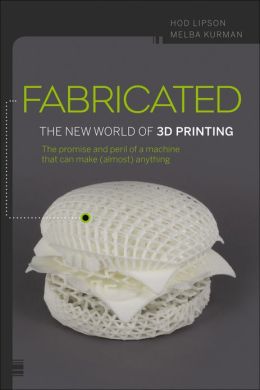
3D Printing's Potential Explored In Fabricated
3D Printing
| Fabricated, the new book by Hod Lipson and Melba Kurman provides readers with practical and imaginative insights to the question "how will 3D printing technologies change my life?" Based on hundreds of hours of research and dozens of interviews with experts from a broad range of industries, Fabricated offers readers an informative, engaging and fast-paced introduction to 3D printing now and in the future. |
The scenario seems like science fiction, but Lipson and Kurman make a compelling case that some version of it is not far off.
3D printing creates objects by building up successive layers of material, is poised to shake up everything from manufacturing to medicine according to the authors.
Based on hundreds of hours of research and dozens of interviews with experts from a broad range of industries, Fabricated offers readers an informative, engaging and fast-paced introduction to 3D printing now and in the future. Written by two leading experts on 3D printing, Fabricated is the first book to address both the practical and imaginative insights to the question “how will this technology change my life?”
Lipson, a robotics engineer at Cornell University, and technology analyst Kurman explore how these machines are already wending their way into many facets of society, including food, fashion and education.
Thursday, February 21, 2013
Mike Friton - The Innovator
Design
| Mike Friton is a freelance shoemaker, weaver, paper sculptor and innovator with over 30 years of experience at Nike. In a short video, Friton, tells his story of how he came to be known as "The Innovator." |
In this video from Cineastas, former track and field athlete at the University of Oregon and designer, Friton, tells his story of how he came to be known as "The Innovator."
In high school, Friton decided to join the school's track and field team, which would lead him to the University of Oregon where he specialized in the Steeplechase. The event required an athlete to jump over five hurdles and then move on to a water jump.
Designing and putting together his first shoe, Friton took into account the amount of weight the shoe had stepping out of the water. He then figured out how to include holes in the structure in a way that wouldn't damage the shoe’s integrity.
Friton is the type of designer that goes above and beyond by thinking of mind-boggling ways to expand the variation of athletic footwear.

The Retro Future World of Bruce McCall

Bruce McCall
| Artist Bruce McCall paints images of 'Retro Futurism,' with a tongue-in-cheek humorous approach. future that never was full of flying cars, polo-playing tanks and the RMS Tyrannic, "The Biggest Thing in All the World." |
Born and raised in Canada, where he was a high-school dropout, McCall is a largely self-taught artist and writer who returned to his first love, humor and satire, after careers in commercial art, journalism, and advertising.
A longtime contributor to the New Yorker, McCall's best-known work draws on the big-shouldered hubris of the middle 1920s and the early 1950s to create future paradises where the skies are fllled with zeppelins and every car has wings. He's a wry observer of contemporary life and a witty writer.
McCall began his career as an illustrator for car ads -- by his own account not a very good illustrator. He'd left the field and became a copywriter when, on a whim, he and a friend sent some humorous drawings to Playboy. He soon connected with the founders of the National Lampoon, a pioneering humor magazine, and went on to create some of their most enduring images -- finding in the 1970s counter-cultural media a rich audience for his satirical take on the Atomic Age. He's now working the same magic at the New Yorker. His latest book is called Marveltown
 , and is exactly what it sounds like. McCall's latest book is called 50 Things to Do with a Book
 .
.
Friday, February 15, 2013
The Design Surgery's Report Graphics Provide Clear and Effective Information With Style

| The London design agency, Design Surgery has completed a series of designs for reports that provide companies and organisations with an effective, informative and powerful communications platform for Raconteur Media. |
Each cover visualizes a detailed scene to demonstrate the themes covered throughout the report. The Design Surgery's use of detail, curves and simplified shapes build a cohesive brand image for Raconteur Media.
Illustrated and designed by London design agency, these reports provides companies and organisations with an effective, informative and powerful communications platform that allows them to directly reach their core audience. Raconteur brings together content and sponsors in a credible package of quality journalism and cutting-edge design.
The Design Sugery is a creative agency that thrives on contemporary design. "We are graphical surgeons, passionate problem solvers, emotionally and ethically driven," states their website.
The company prides itself on their in-depth knowledge of visual communication, brand awareness and targeted design. "We examine the boundaries of our clients requirements, revealing a brand's purpose and personality. By identifying the role in which a brand should play, we are able to grasp an accurate understanding of the links between business, brand and consumer."
According to The Design Surgery, design can have a profound effect on how we feel both mentally and physically.

Thursday, February 14, 2013
SCI-Arc Students Explore The Future Of Robotic Architecture

Architecture
| Accelerating The Southern California Institute of Architecture into the 21st Century the new SCI-Arc Robot House, initiated and designed by faculty members Peter Testa and Devyn Weiser, builds upon the school's strengths to create a next generation platform for experimentation and speculation on the future of architecture. |
The course explores robotic motion control as a creative medium for designers, mainly through the use of the custom robotic animation software platform, designed specifically for the SCI-Arc Robot House.
Accelerating SCI-Arc's pace, already at the leading edge of digital design and rapid prototyping, the new SCI-Arc Robot House, initiated and designed by faculty members Peter Testa and Devyn Weiser, builds upon the school's strengths to create a next generation platform for experimentation and speculation on the future of architecture.
Situated conceptually and physically between studio and shop, academy and industry, the double-height 1,000-square-foot Robot House is a research space for hands-on collaborative experimentation, advanced multi-robotic platform, and exploration and architectural agency. Exploring opportunities outside of traditional digital production, our six state-of-the-art Staübli robotic systems offer a new design environment which focuses on Institute-approved research and coursework.
Robot House is comprised of two main spaces. The Robot Room is where the five large Staubli robots are configured in a multi-robot work cell. Their layout empowers investigation with the widest range of interaction and process sequences possible in a simulation and programming environment.
Monday, February 11, 2013
Vertebrae Staircase Concept Inspired by Whale Skeleton

Andrew Lee McConnell
| Inspired by the spine of a whale, the Vertebrae Staircase by Andrew Lee McConnell is not simply mimicry of organic form but an exploration in shaping structure. |
Much of the design work went into refining the single component, or vertebra, that mate with each other creating a unified spine running from floor plate to floor plate. These interlocking vertebrae create a rigid and self-supporting structure.
The outer surface is composed of multiple layers of a durable composite fibre material while inside are the key structural elements. The vertebrae are mated using steel fittings and locked together with steel pins.
When all the connections are made, continuous structural spirals run through every vertebra at the hand rail and beside each step, reinforced by structural foam and a network of steel rods. Steel plates connected to the slightly modified base and top vertebrae are anchored to the floors.
Beyond this, there are no hidden supports as the Vertebrae Staircase is designed to act as one structural element, bearing the loads of its users and transferring these forces to the floor plates. And the pinned connections at the floor plates combined with the connections between vertebrae allow the staircase to successfully resist twisting and rotational forces that result from the cantilevered spiral and cantilevered steps.
Step, banister and hand railing – McConnell could clearly see all these elements contained within a whale's vertebrae and spine. The Vertebrae Staircase is a reconfiguration of this familiar form resulting in a unique and functional design. —

Friday, February 8, 2013
Alexander Lervik - Spike Chair

Alexander Lervik
| One of the top designers in Sweden has a new limited-edition chair inspired by a rainy trip to the Philippines Alexander Lervik's Spike Chair is as mush about sculpture as it is about seating. |
Though his main focus is lighting, furniture and product design, he also creates concepts for hotel and restaurant interiors and collaborate with fashion brands. Throughout the years, Lervik has received a number of awards, amongst them Best of The Best at 100% Design, +1 Best in show at Stockholm Furniture fair, Utmärkt Svensk Form and the prestigious award Design S. he is represented at Nasjonalmuseum in Oslo, Nationalmuseum in Stockholm and the design museum Rhösska in Gothenburg, Sweden. —
Lervik's Spike chair is unique in shape. The seat and seat back are fashioned from a number of rods, like a bed of nails, which collectively mimic the curve of a body. The base of the chair is made of tubular steel, welded together with a three-millimetre steel base plate. The upper section is made of turned ash components.

Wednesday, February 6, 2013
Close Enough Doesn't Cut It: Differences in Color

Color
| In this guest post, author Daniel Harris examines the fine techniques of color matching that are used in nearly every product manufactured today. With plastic parts and metal parts requiring seamless design integration in final assembly, color matching is essential to industrial design and manufacturing. |
But when it comes to production even the smallest mistake can potentially cost millions of dollars. Mistakes with color can easily happen, especially if parts are being manufactured in different plants. Everyone perceives color differently based on mood, age, health, and a host of other factors. When it comes to production, here are some of the biggest factors when it comes to choosing and matching color.
• Light Source: Light changes the most underneath different lighting which is too be expected since color is simply a reflection and absorption of light waves. Different lighting has different spectrums and materials will latterly reflect the changes by being a different color. Imagine you’re designing a sports jersey for a large college or professional football team. The fabric looks great in your studio, but underneath the halogen lights something is off. Products need be tested underneath an agreed upon light source for consistent results.
• Different Materials: Car manufacturers deal with this all the time. The soft grey on the hard plastic dash needs to be the same soft grey as the plush faux leather seats, but the two materials reflect light differently. This means a different solution is needed for each material to get the same result.
• Different Surfaces: Even though you may have the same material, the material can have different surface textures and finishes. A rough texture will not look as bright as a smooth texture just like gloss will appear much brighter than matte.
Monday, February 4, 2013
Japanese Designer Uses Motion To Reveal Hidden Typography

Typography
| The Japanese designer going by the alias, MountStar has taken playful motion graphics to new heights, while using minimalist techniques. In "Hidden Typography," motion graphics are used to reveal words unseen on plain black backgrounds. |
The designer's minimalist take on typography is a playful and effective use of the tools of graphic design to deliver maximum effect.
The series titled, "Hidden Typography," uses motion graphics to reveal words unseen on plain black backgrounds. Water-inspired lines pour over the word, and beams of lines bounce around to reveal another example.


3D Print Art Representing Your Facebook Relationships

| As part of a part of a collaboration of SOFTlab with The Creators Project uses algorithms and 3D printing to create data visualizations of your Facebook relationships. |
SOFTlab is a design studio based in New York City. The studio was created by Michael Szivos shortly after receiving a graduate degree in architecture from the Graduate School of Architecture, Planning and Preservation at Columbia University.
The studio has since been involved in the design and production of projects across almost every medium, from digitally fabricated large-scale sculpture, to interactive design, to immersive digital video installations. As the studio adjusted to a wide range of projects, we began to focus less on the medium and style and more on ideas.
You can check it out here along with other projects done by Sticky Monster Lab and Sosolimited.

 | |