
|
|
 | |

Showing posts with label industrial design. Show all posts
Showing posts with label industrial design. Show all posts
Wednesday, February 26, 2014
The Art of Product Design


Design
| The Art of Product Design by Hardi Meybaum explains the rise of Open Engineering, a way of breaking down barriers and taking advantage of web-based communities, knowledge, and tools to accelerate the design and manufacturing processes. |
explains the rise of "Open Engineering," a way of breaking down barriers and taking advantage of web-based communities, knowledge, and tools to accelerate the design and manufacturing processes.The book helps explain how to establish open flows of information inside and outside an organization, increasing the quality and frequency of input from different groups and stakeholders.

Monday, June 10, 2013
Remembering Niels Diffrient

Design
| The iconic American industrial designer, Niels Diffrient has passed away at the age of 84. Diffrient will be remembered for his bringing ergonomics to the fore in design and for his famous Freedom Chair. |
The iconic American designer has passed away at the age of 84.
Diffrient's three-volume reference work, Humanscale, explores the relationship of spine to chair and other "human engineering" data necessary for highly specialized workplaces such as a cockpit or a truck cab, as well as aiding in the search for the perfectly comfortable place to sit down.
In the field of furniture design, most notably ergonomic seating, Niels won a total of 24 awards, including two Best of Show and 10 Gold and Top awards. Diffrient holds more than 46 design and utility patents on furniture designs in America and abroad, and his many honors include the I.D. (magazine) Top 40 Design Innovators of 1996, the 1996 Chrysler Award for Innovation, the Smithsonian’s 2002 Cooper-Hewitt National Design Award for Product Design, and the 2005 Legend Award from Contract magazine.
In the field of furniture design, most notably ergonomic seating, Niels won a total of 24 awards, including two Best of Show and 10 Gold and Top awards. Diffrient holds more than 46 design and utility patents on furniture designs in America and abroad, and his many honors include the I.D. (magazine) Top 40 Design Innovators of 1996, the 1996 Chrysler Award for Innovation, the Smithsonian’s 2002 Cooper-Hewitt National Design Award for Product Design, and the 2005 Legend Award from Contract magazine.

Friday, April 26, 2013
Self-Assembling Furniture

Design
| Carl de Smet has developed a concept for self-assembling furniture that’s just as cool to watch. Once removed from the box, his block of smart foam quickly unfolds and stretches into a perfectly useable chair. |
The technology arrives at a dynamic moment in materials design. With 3D printing becoming affordable enough to use for more than just prototypes, other designers, entrepreneurs, and researchers are either reviving older techniques that the 3D printing craze has overshadowed or introducing even newer concepts, like 4D Printing another smart materials concept rolled out at TED last month.

SOURCE Fast Company Co.Exist
| By kree8tiv | Subscribe to kree8tiv |
Thursday, April 18, 2013
Tom Dixon Looks To Open Source For His Next Design Move
| Industrial designer Tom Dixon and Dassault Systèmes have teamed up to create the first open design competition based on a modular concept. Dixon will give participants access to the design files of new products, and challenge them to re-configure and remix into different functional objects. |
In a bold move, Dixon will give participants access to the design files of new products, and challenge them to re-configure and remix into different functional objects.
This new modular rapid manufacture concept leverages 3D printing technology to create junctions, which will then be combined and assembled with aluminum tubes to complete truss-like structures.
3D printing, which was previously limited to small parts, can now be used to create real life products - such as furnitures for instance. This concept will lead to unique and innovative objects.
 |
| Tom Dixon |

The concept is also relying on the fact that the various parts and "joints", may be 3D printed to give life to the final creation. The contest will start on April, 8th and we will accept submissions until June, 30. The winner will be chosen by the jury on July, 31st. —
The winning entry, chosen by a jury including Tom Dixon, will receive an iPad, his concept 3D printed and assembled and featured at the Maison & Object trade show in Paris.

| By kree8tiv | Subscribe to kree8tiv |


Saturday, February 23, 2013
3D Printing's Potential Explored In Fabricated
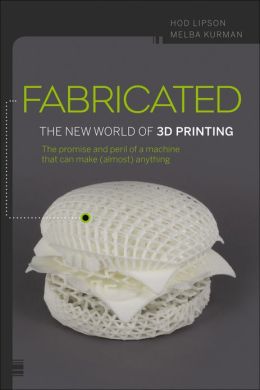
3D Printing
| Fabricated, the new book by Hod Lipson and Melba Kurman provides readers with practical and imaginative insights to the question "how will 3D printing technologies change my life?" Based on hundreds of hours of research and dozens of interviews with experts from a broad range of industries, Fabricated offers readers an informative, engaging and fast-paced introduction to 3D printing now and in the future. |
The scenario seems like science fiction, but Lipson and Kurman make a compelling case that some version of it is not far off.
3D printing creates objects by building up successive layers of material, is poised to shake up everything from manufacturing to medicine according to the authors.
Based on hundreds of hours of research and dozens of interviews with experts from a broad range of industries, Fabricated offers readers an informative, engaging and fast-paced introduction to 3D printing now and in the future. Written by two leading experts on 3D printing, Fabricated is the first book to address both the practical and imaginative insights to the question “how will this technology change my life?”
Lipson, a robotics engineer at Cornell University, and technology analyst Kurman explore how these machines are already wending their way into many facets of society, including food, fashion and education.
Friday, February 8, 2013
Alexander Lervik - Spike Chair

Alexander Lervik
| One of the top designers in Sweden has a new limited-edition chair inspired by a rainy trip to the Philippines Alexander Lervik's Spike Chair is as mush about sculpture as it is about seating. |
Though his main focus is lighting, furniture and product design, he also creates concepts for hotel and restaurant interiors and collaborate with fashion brands. Throughout the years, Lervik has received a number of awards, amongst them Best of The Best at 100% Design, +1 Best in show at Stockholm Furniture fair, Utmärkt Svensk Form and the prestigious award Design S. he is represented at Nasjonalmuseum in Oslo, Nationalmuseum in Stockholm and the design museum Rhösska in Gothenburg, Sweden. —
Lervik's Spike chair is unique in shape. The seat and seat back are fashioned from a number of rods, like a bed of nails, which collectively mimic the curve of a body. The base of the chair is made of tubular steel, welded together with a three-millimetre steel base plate. The upper section is made of turned ash components.

Wednesday, February 6, 2013
Close Enough Doesn't Cut It: Differences in Color

Color
| In this guest post, author Daniel Harris examines the fine techniques of color matching that are used in nearly every product manufactured today. With plastic parts and metal parts requiring seamless design integration in final assembly, color matching is essential to industrial design and manufacturing. |
But when it comes to production even the smallest mistake can potentially cost millions of dollars. Mistakes with color can easily happen, especially if parts are being manufactured in different plants. Everyone perceives color differently based on mood, age, health, and a host of other factors. When it comes to production, here are some of the biggest factors when it comes to choosing and matching color.
• Light Source: Light changes the most underneath different lighting which is too be expected since color is simply a reflection and absorption of light waves. Different lighting has different spectrums and materials will latterly reflect the changes by being a different color. Imagine you’re designing a sports jersey for a large college or professional football team. The fabric looks great in your studio, but underneath the halogen lights something is off. Products need be tested underneath an agreed upon light source for consistent results.
• Different Materials: Car manufacturers deal with this all the time. The soft grey on the hard plastic dash needs to be the same soft grey as the plush faux leather seats, but the two materials reflect light differently. This means a different solution is needed for each material to get the same result.
• Different Surfaces: Even though you may have the same material, the material can have different surface textures and finishes. A rough texture will not look as bright as a smooth texture just like gloss will appear much brighter than matte.
Thursday, January 24, 2013
Should Jonathan Ive Takeover At Apple?

Industrial Design
| Apple will soon be reporting its first profit drop in many years. According to Peter Cohan this outcome brings into clearer focus the biggest challenge facing Apple’s board: Is Tim Cook the person for the CEO job and if not, who would be better? Cohan points his finger directly at Jonathan Ive. |
"Now it's time," Cohan writes, "for Apple's board to put the person with design skill in the CEO job."
Ive's impact on Apple has been considerable since Steve Jobs returned to helm the company in 1997. At that time, Jobs refocused the company to once again become a design-first leader in the industry.
With the iMac and the iPod to the iPad
 and iPhone, Jobs and Ive in tandem brought the company to soaring heights and the design to new levels of simplicity and ubiquity.
 | |